Benefits of personalised books: what the research says
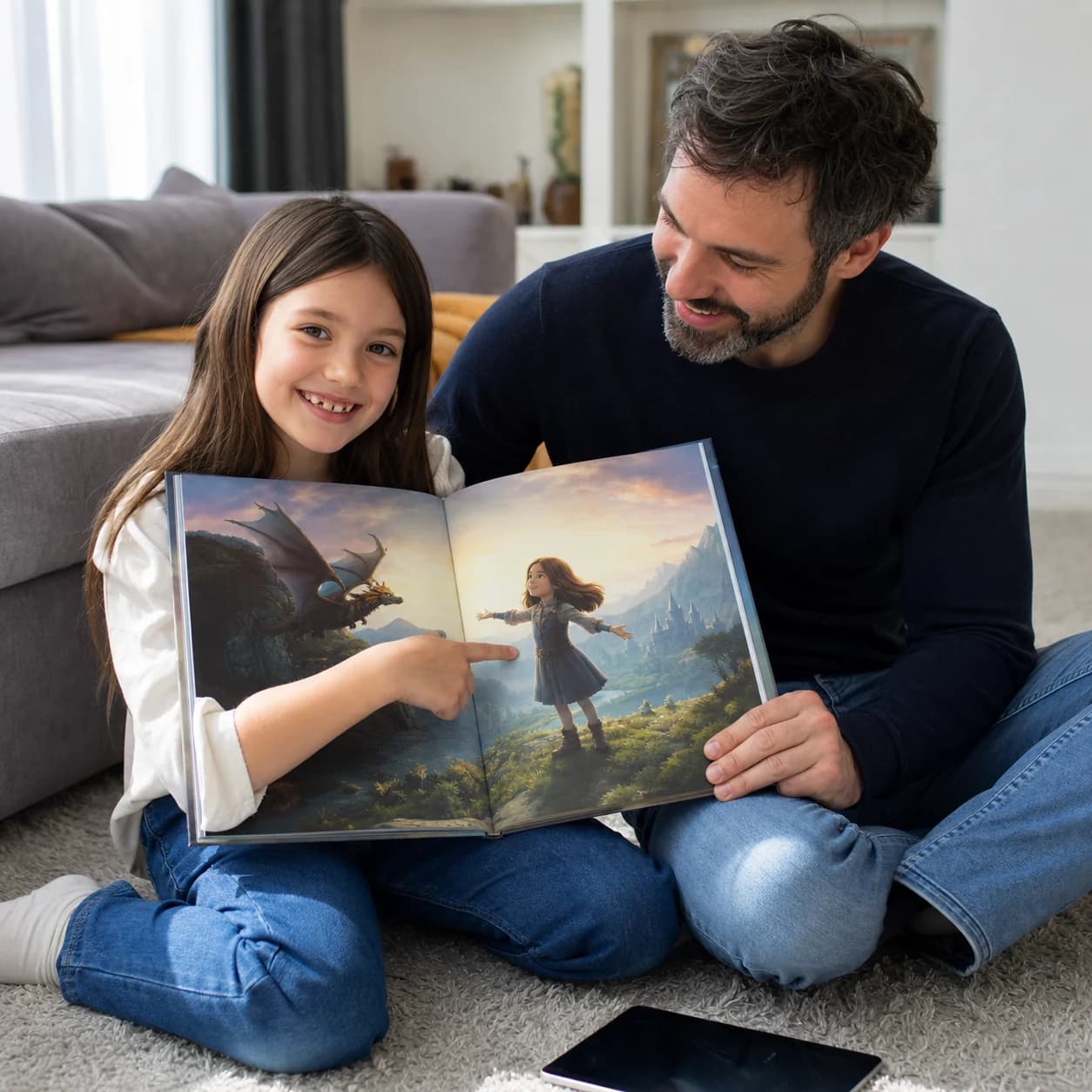
Research suggests personalised books can make shared reading more engaging for young children and, in at least one small experiment, help them learn new words. A likely mechanism is the self-reference effect: we remember information linked to ourselves better. The evidence is promising but limited — small studies, mostly with under-sixes, measuring short-term effects.
What is the self-reference effect?
The self-reference effect is our tendency to remember information better when we relate it to ourselves. Described by Rogers, Kuiper and Kirker (1977) and confirmed in a meta-analysis by Symons and Johnson (1997), it is one reason researchers expected personalised books to help children.
In the original experiments, adults judged adjectives by how they looked, how they sounded, what they meant or whether they described them. In a surprise recall test, words judged against “Does this describe you?” were remembered best (Rogers et al., 1977). The meta-analysis suggests why: the self is a rich, well-practised mental structure that encourages deeper, better-organised processing (Symons & Johnson, 1997).
Children show it too. In a study of 64 children aged 4 to 6, toys they had “owned” in a sorting game were recognised better than toys assigned to someone else, and the advantage shrank with age (Cunningham et al., 2013). A meta-analysis of 13 education studies found that self-referencing generally improved learning, except with negative material (Liu et al., 2024).
What do studies on personalised children's books show?
A handful of small controlled studies, most led by Natalia Kucirkova and colleagues in the UK, found more smiles, laughter and talk with personalised books, and in one case better word learning. A 2025 kindergarten study found better story retelling and comprehension.
| Study | Children | Comparison | Main finding |
|---|---|---|---|
| Kucirkova, Messer & Whitelock (2013) | 7 children aged 12–33 months, with a parent | Personalised vs generic vs favourite book | More smiles and laughter than with the generic book |
| Kucirkova, Messer & Sheehy (2014a) | 18 children, mean age 3 years 10 months | Personalised vs generic sections of one book | Better knowledge of new words from personalised sections |
| Kucirkova, Messer & Sheehy (2014b) | 35 children, mean age about 3 years | Personalised vs generic part of a book | More talk and more “me” and “my” |
| Kucirkova et al. (2021) | 26 mothers with 3- and 4-year-olds | Personalised vs generic pages of a digital book | Child talk mostly concrete and about themselves |
| Neuenschwander et al. (2025) | 80 kindergarten children | Personalised vs traditional copy of a book | Better retelling and comprehension; involvement gains mostly in darker-skinned children |
Together, these studies suggest that seeing themselves in a story makes young children more emotionally and verbally involved. But they are small, and several come from one research team, so they show what can happen rather than what always happens.
Do personalised books help children learn new words?
Possibly, for some children. In one experiment, preschoolers learned unfamiliar words better from the personalised sections of a book than from generic ones. It was a single study with 18 children, so the finding is encouraging rather than conclusive.
Each child heard the same picture book twice, a week apart, with real but unfamiliar words placed in both kinds of section. The advantage for personalised sections showed up at the later tests: a week after the first reading and after the second (Kucirkova, Messer & Sheehy, 2014a).
Another study adds nuance: on personalised pages of a digital book, three- and four-year-olds talked mostly about concrete things and themselves, while mothers talked more about other characters. The authors stress the parent's role in taking the conversation beyond the child's own world (Kucirkova et al., 2021).
Why does how you read matter as much as the book?
Because the strongest evidence is for interactive reading, not for any type of book. When adults ask open questions, expand the child's answers and let them retell the story, children's expressive vocabulary tends to grow more than when the book is simply read through.
This approach, dialogic reading, was first tested with parents who learned to ask more questions and give feedback; their children scored higher on expressive language than a control group (Whitehurst et al., 1988). A meta-analysis later found a moderate added benefit for expressive vocabulary, smaller for 4- and 5-year-olds and for children at risk of language difficulties (Mol et al., 2008).
Results vary. A review of 19 randomised trials found small effects on child language, and minimal ones when the programme dose was low (Dowdall et al., 2020). Another meta-analysis found smaller effects than earlier reviews, and negligible ones against active control groups (Noble et al., 2019).
What does the research not show?
It does not show that personalised books make children better readers in the long term, that every child benefits, or that personalisation beats good shared reading. The studies are small and short, mostly with under-sixes, and several come from the same research group.
- Small samples: the studies above involved between 7 and 80 children.
- Short time frames: outcomes were measured within days or weeks, with no long-term follow-up we could find.
- Young children only: almost all participants were under 6, so evidence for ages 7–10 is thin.
- Uneven effects: in the 2025 study, some benefits appeared mainly in darker-skinned children.
- A focus on “me”: personalised reading goes with more self-referential talk; a conceptual paper suggests balancing it with stories that stretch children towards unfamiliar worlds and other perspectives (Kucirkova & Littleton, 2020).
- Tone matters: self-referencing had an adverse effect with negative material (Liu et al., 2024) — one reason to keep the child's role in the story positive.
How can you get the most from reading a personalised book together?
Read it more than once, pause to let your child talk, and use the personalised moments as a springboard to other characters and ideas. Short, warm, regular sessions matter more than finishing quickly.
- Let your child find themselves: “Where are you on this page?” Pointing and naming is real language practice.
- Ask open questions: “What do you think happens next?” invites longer answers than a yes-or-no question.
- Expand what they say: if your child says “Big fish!”, reply “Yes, a huge silver fish under the boat.”
- Turn the spotlight outwards: “How do you think the dragon felt?”
- Reread: familiar stories let children join in, predict and eventually retell them.
Match length and themes to your child's stage with our guide to personalised books by age, or make the story part of a calm routine with personalised bedtime stories. For an overview of the format, see personalised children's books.
Frequently asked questions
Will a personalised book make my child a better reader?
We found no study showing that a personalised book on its own improves long-term reading. Research supports regular, interactive reading with an adult; a personalised book can make that habit more appealing.
Can personalised books make children self-centred?
We found no study showing that. Personalised reading does prompt more talk about “me”, and researchers suggest balancing it with stories about other people and places. Asking how other characters feel helps.
At what age is the evidence strongest?
Roughly between 1 and 6. The main studies involved toddlers, preschoolers and kindergarten children. For ages 7 to 10 there is little direct research, so benefits there are a reasonable hope rather than a proven effect.
Does it matter whether the book uses my child's photo or just their name?
Studies have personalised names, photos, favourite things and appearance, but we found none testing which feature matters most. What seems to count is that the child recognises themselves and feels part of the story.
Is a digital personalised book as good as a printed one?
We found no study comparing screen and paper versions of personalised books directly, and at least one study above used a digital book. Whatever the format, an adult reading along and talking seems to matter most.
Have AI-illustrated personalised books been studied?
Research on AI-made personalised stories is only beginning, and the findings above come from books personalised in other ways. AI changes how the pictures are made, not the idea of seeing yourself in a story, but identical results should not be assumed.
Sources
- T. B. Rogers, N. A. Kuiper, W. S. Kirker (1977). Self-reference and the encoding of personal information. Journal of Personality and Social Psychology, 35(9), 677–688
- C. S. Symons, B. T. Johnson (1997). The self-reference effect in memory: A meta-analysis. Psychological Bulletin, 121(3), 371–394
- S. J. Cunningham, F. Vergunst, C. N. Macrae, D. J. Turk (2013). Exploring early self-referential memory effects through ownership. British Journal of Developmental Psychology, 31(3), 289–301
- Z. Liu, J. Wen, Y. Liu, C.-P. Hu (2024). The effectiveness of self: A meta-analysis of using self-referential encoding techniques in education. British Journal of Educational Psychology, 94(1), 112–137
- N. Kucirkova, D. Messer, D. Whitelock (2013). Parents reading with their toddlers: The role of personalization in book engagement. Journal of Early Childhood Literacy, 13(4), 445–470
- N. Kucirkova, D. Messer, K. Sheehy (2014). Reading personalized books with preschool children enhances their word acquisition. First Language, 34(3), 227–243
- N. Kucirkova, D. Messer, K. Sheehy (2014). The effects of personalisation on young children's spontaneous speech during shared book reading. Journal of Pragmatics, 71, 45–55
- N. Kucirkova, M. Gattis, T. P. Spargo, B. Seisdedos de Vega, R. Flewitt (2021). An empirical investigation of parent-child shared reading of digital personalized books. International Journal of Educational Research, 105, 101710
- N. Kucirkova, K. Littleton (2020). The distance between the “self” and the “other” in children’s digital books. Frontiers in Psychology, 11, 589281
- R. Neuenschwander, P. Brüniger, C. Fellmann (2025). Personalization effects on child involvement during shared book reading: Do children of color benefit most?. European Journal of Psychology of Education, 40(4), 132
- G. J. Whitehurst, F. L. Falco, C. J. Lonigan, J. E. Fischel, B. D. DeBaryshe, M. C. Valdez-Menchaca, M. Caulfield (1988). Accelerating language development through picture book reading. Developmental Psychology, 24(4), 552–559
- S. E. Mol, A. G. Bus, M. T. de Jong, D. J. H. Smeets (2008). Added value of dialogic parent–child book readings: A meta-analysis. Early Education and Development, 19(1), 7–26
- N. Dowdall, G. J. Melendez-Torres, L. Murray, F. Gardner, L. Hartford, P. J. Cooper (2020). Shared picture book reading interventions for child language development: A systematic review and meta-analysis. Child Development, 91(2), e383–e399
- C. Noble, G. Sala, M. Peter, J. Lingwood, C. Rowland, F. Gobet, J. Pine (2019). The impact of shared book reading on children's language skills: A meta-analysis. Educational Research Review, 28, 100290
See your child as the hero — free
Create a free preview with the cover and first illustrated page. No account, no card — you only pay if you like what you see.
Create the free previewKeep reading
Personalised children’s books: the complete guide
What personalised children’s books are, the main types, how AI-made books work, prices, ages and photo privacy: a neutral guide to choosing well.
Read the guide →Personalised books by age: what works from 2 to 12
How to choose a personalised children's book by age: text per page, vocabulary, themes, pictures and whether 12, 18 or 24 pages suits a child aged 2 to 12.
Read the guide →Personalised bedtime stories: helping children sleep (and sleep alone)
How a calm routine and a story starring your child can ease fear of the dark and sleeping alone, with tips by age and a sample bedtime routine.
Read the guide →A personalised book to prepare your child for a new sibling
How a personalised story prepares your child for a new baby brother or sister: common reactions, what the book should include, when to read it and tips by age.
Read the guide →