Personalised books by age: what works from 2 to 12
A good personalised book grows with the child: one or two repetitive sentences and a clear picture per page at 2–3, a simple adventure at 4–5, a fuller plot the child can partly read at 6–7, and richer language with real choices at 8–10. Length should follow attention span: 12 pages for toddlers, 24 for confident readers.
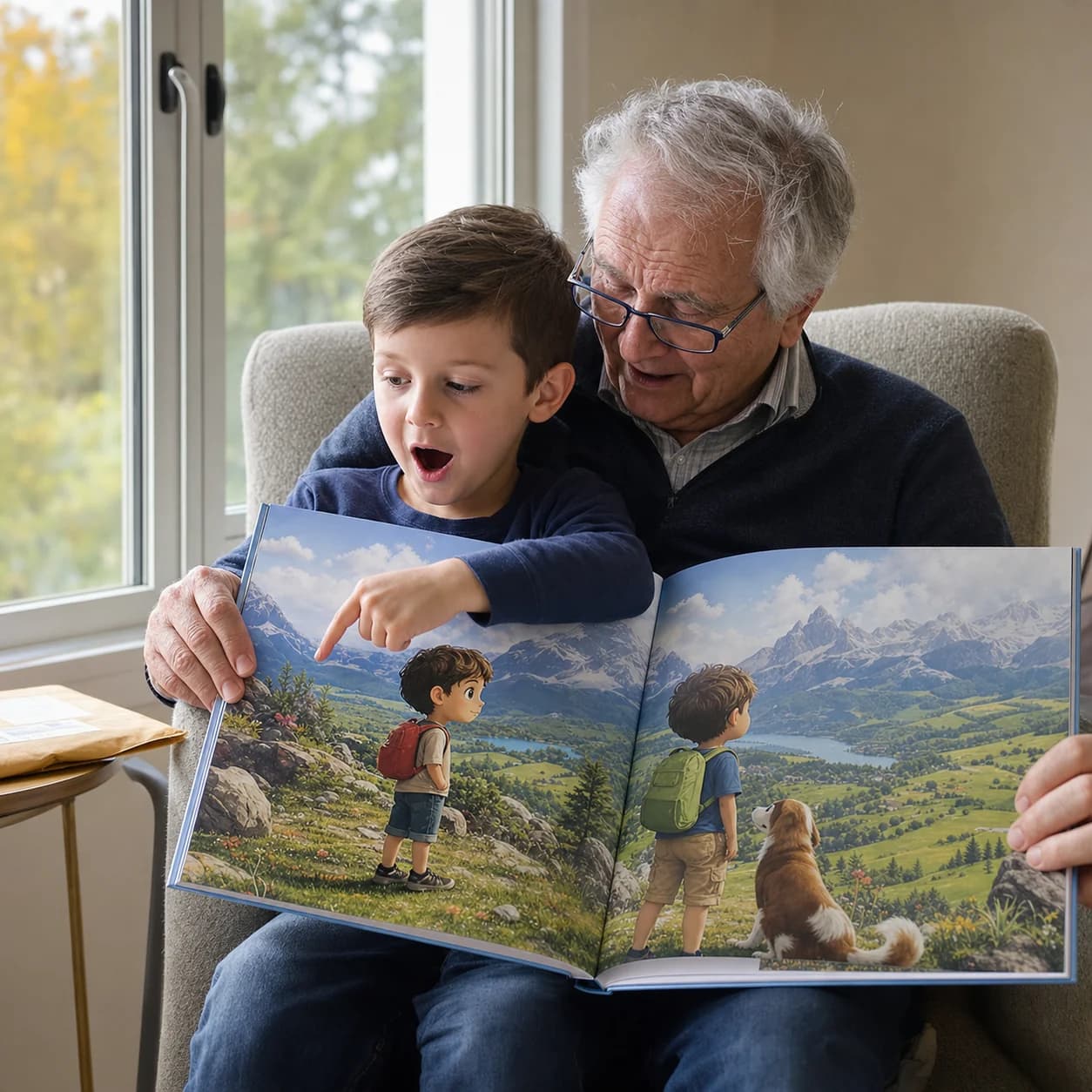
What changes in a children's book between ages 2 and 12?
Five things change with age: text per page, the difficulty of words and sentences, plot complexity, how much the pictures carry the story, and who does the reading. A book that delights a three-year-old will usually bore an eight-year-old, and vice versa.
| Age | Text per page | Language | Themes that work | Who reads | Suggested length |
|---|---|---|---|---|---|
| 2–3 | 1–2 short sentences (about 10–25 words) | Concrete words, repetition, sounds | Routines, animals, family, bedtime | An adult, aloud | 12 pages |
| 4–5 | 2–4 sentences (about 20–40 words) | A few new words; simple dialogue | Small adventures, friendship, starting school | Together; the child joins in | 12 or 18 pages |
| 6–7 | A short paragraph (about 30–50 words) | Short sentences, lively dialogue, humour | Quests, mild suspense, perseverance | Shared; the child reads parts | 18 or 24 pages |
| 8–10 | 1–2 paragraphs (about 40–70 words) | Richer vocabulary, nuanced feelings | Mysteries, big challenges, real choices | Often alone, still good together | 24 pages |
The word ranges are an editorial rule of thumb, not a research standard. For the basics, see our guide to personalised children's books.
What makes a good personalised book for a 2- or 3-year-old?
At 2–3, the best books are short, rhythmic and concrete: one or two simple sentences per page, plenty of repetition and one big, clear picture. Seeing their own name and face gives toddlers an instant reason to point, smile and ask for it again.
- Text: one idea per page and a repeated line the child learns to expect (“And who was there? Olivia!”), with everyday words — splash, cuddle, moon — and sounds to make together.
- Themes: bath time, bedtime, animals, family: familiar settings with a touch of magic.
- Pictures: one clear scene per page, few characters, the child easy to spot.
- Reading: always with an adult, pausing so the child can point or finish the repeated line.
What should a personalised book look like for a 4- or 5-year-old?
At 4–5, children follow a simple adventure: a beginning, a problem, a happy ending. Two to four sentences per page work well, with a few new words the pictures explain. The child in the story should act and decide, not just watch.
- Text: short sentences, some dialogue and one or two new words per page, made clear by the picture (“a gigantic shell — bigger than a car!”).
- Themes: friendship, courage, a new baby, starting Reception, dinosaurs, space, castles.
- Pictures: richer scenes with details to hunt for.
- Reading: together. Many children “read” the story from memory and the pictures — genuine pre-reading.
Their own name is a natural first word to spot, so point to it on every page. Small studies suggest preschoolers get more involved when they see themselves in a story — see what the research says.
What works best for a 6- or 7-year-old?
At 6–7, most children are learning to read, so the book should work read aloud and read in parts by the child. Short paragraphs, lively dialogue, light humour and a few failed attempts before success keep them turning pages.
- Text: a short paragraph per page, mostly words they can sound out, and dialogue to read in character voices.
- Themes: quests, gentle mysteries, perseverance, respecting differences, being brave at school.
- Pictures: still on every page, now supporting the text rather than carrying it.
- Reading: take turns — you read a page, your child reads a line. Their own name is an easy, motivating word to read.
Is a personalised book still a good idea at 8, 9 or 10?
Yes, if it respects their age. Children of 8–10 want richer vocabulary, a real challenge and choices with consequences — not a babyish story with their name dropped in. Nuanced feelings, humour and an art style they find cool all matter.
- Text: one or two paragraphs per page, precise vocabulary, varied sentences and a little figurative language.
- Themes: mysteries, exploration, sport, science, believing in yourself, standing up for a friend.
- Pictures: cinematic scenes; some children this age prefer anime or 3D animation to soft watercolour.
- Reading: many read alone, but reading together is a chance to talk about the hero's choices.
What changes at 11 and 12?
At Heroica, these ages have their own narrative directions: competing perspectives, meaningful choices and more room for subtext. An illustrated story can invite a sophisticated reading without becoming a long novel.
Age is a starting point, not a reading test. Prior experience, interests and support matter. Reading together remains welcome; choose 12, 18 or 24 pages for the reading experience you want, not as a measure of ability.
Which school years match each age?
In England, ages 4–5 match Reception, 6–7 match Years 1–2 (Key Stage 1) and 8–10 match Years 3–5 (Key Stage 2). In the US, the same ages roughly match pre-K and kindergarten, 1st–2nd grade and 3rd–5th grade.
| Age | England | United States | Reading at this stage |
|---|---|---|---|
| 2–3 | Nursery or pre-school (Early Years Foundation Stage) | Preschool | Listening, pointing, joining in with rhymes |
| 4–5 | Pre-school, then Reception | Pre-K, then kindergarten | Letters and sounds; phonics normally starts in Reception |
| 6–7 | Years 1–2 (Key Stage 1) | 1st–2nd grade | Decoding; phonics screening check in Year 1 |
| 8–10 | Years 3–5 (Key Stage 2) | 3rd–5th grade | Fluency and independent reading |
Scotland and Northern Ireland use Primary 1 to Primary 7 instead. Exact placement depends on the birthday, and children in the same class can be at very different reading stages.
How do you adapt the same theme to different ages?
Keep the theme and change the challenge. A space story at 3 can be about saying goodnight to the moon; at 6, a mission to fix a rocket; at 9, a difficult decision that tests the hero's values.
| Age | Story idea | What the child takes away |
|---|---|---|
| 2–3 | Amelia waves to the stars and says goodnight to the moon. | Comfort and a calm bedtime |
| 4–5 | Noah helps a lost little star find its way home. | Kindness and courage |
| 6–7 | Olivia fixes a broken rocket after two attempts go wrong. | Perseverance |
| 8–10 | George must choose between winning a space race and helping a rival. | Self-belief and doing the right thing |
- Sleeping alone: a cosy routine at 3; facing the dark with a plan at 7. More ideas in personalised bedtime stories.
- A new sibling: reassurance that there is love for everyone at 2–3; a proud big-sibling role at 5–6. See books for a new sibling.
With Heroica, vocabulary and sentence length follow the age you enter (2 to 12). Books come in 12, 18 or 24 pages, and you see the free preview before paying.
Frequently asked questions
My child is between two age bands — which should I choose?
Go by how your child listens and reads today. For reading aloud, the older band usually works, since children understand more than they can read. For reading alone, choose the younger band so the text feels achievable.
Is a 24-page book too long for a 3-year-old?
Often, in one sitting. Most toddlers prefer short books they can hear again and again. With a longer book, read it in two parts or let your child turn the pages and talk about the pictures.
Should my 8-year-old read the book alone or with me?
Both. Reading alone builds fluency and confidence; reading together lets you talk about the hero's choices. Many families let the child read it first, then share it at bedtime.
My child is a late talker or has additional needs. How do I choose?
Choose by language level and attention span rather than age: shorter text, more repetition, clear pictures. If a service writes to age, check a sample page first to see whether the level suits your child.
Is there an upper age limit for personalised books?
Not a strict one. Heroica's books, for example, are written for ages 2 to 12; older children often move on to chapter books, though a personalised story still works as a keepsake.
See your child as the hero — free
Create a free preview with the cover and first illustrated page. No account, no card — you only pay if you like what you see.
Create the free previewKeep reading
Personalised children’s books: the complete guide
What personalised children’s books are, the main types, how AI-made books work, prices, ages and photo privacy: a neutral guide to choosing well.
Read the guide →Benefits of personalised books: what the research says
What research says about personalised children's books: the self-reference effect, engagement, word learning, the limits of the evidence and reading tips.
Read the guide →Personalised bedtime stories: helping children sleep (and sleep alone)
How a calm routine and a story starring your child can ease fear of the dark and sleeping alone, with tips by age and a sample bedtime routine.
Read the guide →Personalised book gift ideas for every occasion
Personalised book gift ideas for birthdays, Christmas, a new sibling or starting school: which theme and lesson fit, dedication ideas and how to wrap it.
Read the guide →