Personalised bedtime stories: helping children sleep (and sleep alone)
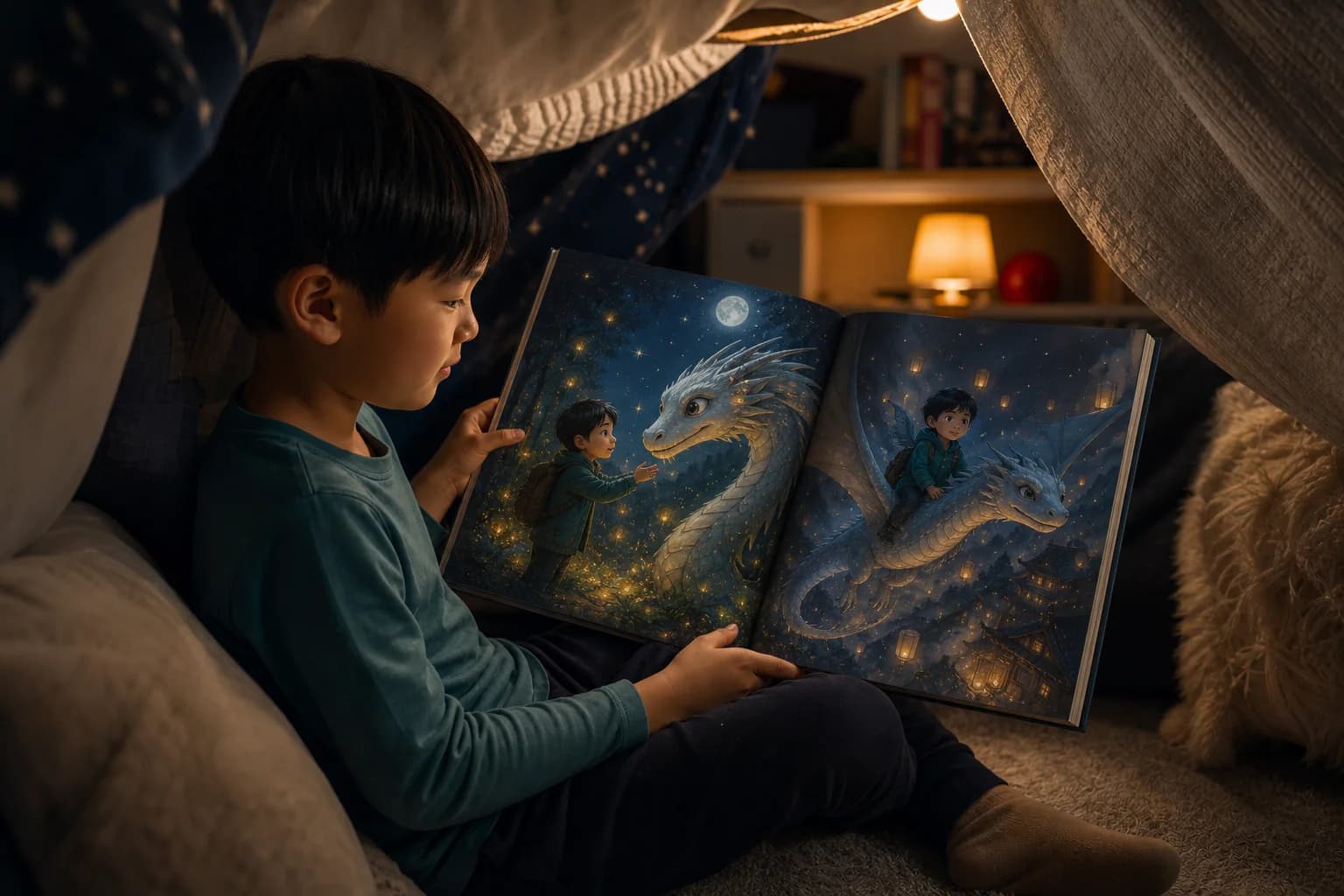
A personalised bedtime story is a short, calm story in which your child is the hero, read as part of the same routine every night. A predictable routine helps children wind down, and seeing themselves face the dark bravely can turn sleeping alone into a mission they want to complete.
Why does a bedtime routine help children sleep?
A calm, predictable routine signals to a child that sleep is coming. Repeating the same few steps in the same order every night makes bedtime feel safe and expected, which usually makes settling easier for the child and for you.
The NHS advises a calming, predictable bedtime routine that happens at the same time and includes the same things every night, starting to wind down around 30 minutes before your child usually falls asleep. The American Academy of Pediatrics sums up a simple version in three words: Brush, Book, Bed.
The story is often the heart of that routine: a few minutes of closeness and undivided attention, and the last voice your child hears before sleep. Reading together also supports language and connection, as our guide to the benefits of personalised books explains.
How can a story where the child is the hero ease fear of the dark?
When the child is the hero, the fear becomes a mission they can complete. Seeing themselves calmly exploring a dark room, befriending a shadow or keeping watch over a sleeping castle gives children a picture of themselves being brave at night.
Fear of the dark and of being alone often appears in the preschool years and, for most children, comes and goes. Reasoning (“there are no monsters”) rarely settles it, because the fear lives in the imagination. A story works in that same place, letting the child rehearse bravery in a world where things turn out well.
Ways to turn night-time worries into a quest:
- The dark room becomes their territory: the child is the night guardian checking that the house is peaceful.
- The night light becomes a lighthouse or a friendly star keeping watch.
- A cuddly toy becomes the sidekick who needs the hero to be brave.
- The mission ends in bed: the hero’s last task is to close their eyes so the kingdom can rest.
What makes a good bedtime story?
A good bedtime story is gentle and predictable: slow pacing, a small problem rather than real danger, some repetition and a warm ending where everyone is safe and sleepy. It should be short enough to finish before your child is overtired.
| Quality | Why it helps at bedtime | What to avoid |
|---|---|---|
| Gentle pacing | Breathing and attention slow down | Chases and cliffhangers |
| Low stakes | The child relaxes instead of worrying | Scary villains, threats to the family |
| Repetition | Familiar lines soothe and invite joining in | A twist on every page |
| A cosy ending | The last image is home, bed and love | “To be continued” |
| The right length | It ends before tiredness turns to tears | Chapters that stop mid-scene |
The Sleep Foundation also advises against scary stories just before bed; save the loudest adventures for daytime.
| Age | What tends to work at bedtime |
|---|---|
| 2–3 years | Very short, one simple idea, lots of repetition, familiar people and toys |
| 4–5 years | A small problem with a clear, happy solution; repetition still welcome |
| 6–8 years | A slightly longer plot, possibly split over nights if each part ends calmly |
| 9–10 years | Longer reads, sometimes alone; keep the final minutes quiet and familiar |
More on vocabulary and length in our guide to personalised books by age. Heroica books come in 12, 18 or 24 pages; shorter books generally suit younger children at bedtime.
How should you read a bedtime story aloud?
Read slowly in a soft voice, dim the lights and let your pace drop towards the end. Keep the same ritual each night and let your child join in with repeated lines. Re-reading the same book is fine: familiarity is part of the comfort.
- Voice: start expressive, then grow quieter and slower; the last pages should sound like a lullaby.
- Lights: a small lamp or a dim night light is enough.
- Ritual: same place, same position, same closing line, such as “and the hero fell fast asleep”.
- Re-reading: asking for the same story night after night is normal; knowing what comes next is soothing.
- Limits: agree beforehand how many stories there will be. The NHS gives the example of one story, then tucking in and saying goodnight.
What does a calm bedtime routine look like?
Most routines follow a few steps in the same order: wind down, wash, pyjamas, teeth, toilet, one story in bed, a cuddle and the same goodnight phrase. The exact steps matter less than repeating them consistently every night.
- Wind down: screens off, quiet play.
- Bath or wash, then pyjamas.
- Teeth and toilet, before the story, not after.
- Choose the book: offer a choice between two.
- Story in bed, lights low, voice slowing down.
- One good thing from the day, shared in a sentence.
- Comfort in place: cuddly toy, and the night light if wanted.
- The same goodnight phrase, then leave while your child is sleepy but still awake.
If sleeping alone is the goal, go in small steps (by the bed, then by the door, then brief check-ins) and praise each brave night the next morning. If a new baby is changing your evenings, see personalised books for a new sibling.
When should you talk to a doctor about night-time fears?
Most fears of the dark fade as children grow. Talk to your GP, paediatrician or health visitor if the fear is intense or lasting, makes settling very hard, or starts to affect play, school, friendships or family life.
Raising Children Network, an Australian parenting resource, suggests seeing a health professional when:
- fear stops your child doing things they want to do, or affects friendships, play, school or family life;
- reactions seem unusually severe, such as great distress or being very hard to settle;
- behaviour is very different from that of other children the same age.
The NHS also suggests talking to your health visitor if sleep problems persist. A story can comfort and motivate, but it is not a treatment; this guide is general information, not medical advice.
Frequently asked questions
At what age do children start to fear the dark?
It often appears in the preschool years, as imagination develops. For most children it is a normal stage that comes and goes and eases with reassurance and a steady routine.
Should I leave a night light on?
If it helps your child feel safe, yes. The NHS suggests a night light or leaving a landing light on for children who are afraid of the dark. A dim, warm light works better than a bright one.
Can a personalised book replace a bedtime routine?
No. A book works best as one step in a routine that stays the same every night: the routine brings predictability, the story brings closeness.
Is there an audio version of Heroica books?
No audiobook is included. Heroica’s home page has a narrated sample at a gentle bedtime pace. After buying a book you can add an optional animated video with the story narrated, but as a screen it suits daytime better.
What if my child keeps asking for one more story?
Agree on the number before you start and hold to it calmly. Letting your child choose which book, rather than how many, gives them some control without stretching bedtime.
Can a bedtime story help when a new baby is on the way?
It can. A new sibling often unsettles sleep, and a story where the older child is the hero helps them feel important rather than replaced. Heroica also offers a “New sibling” lesson.
Sources
- Sleep and young children. NHS
- Brush, Book, Bed: How to Structure Your Child’s Nighttime Routine. HealthyChildren.org (American Academy of Pediatrics)
- Anxiety in children and childhood fears. Raising Children Network
- Danielle Pacheco. Perfecting Your Child’s Bedtime Routine. Sleep Foundation
See your child as the hero — free
Create a free preview with the cover and first illustrated page. No account, no card — you only pay if you like what you see.
Create the free previewKeep reading
A personalised book to prepare your child for a new sibling
How a personalised story prepares your child for a new baby brother or sister: common reactions, what the book should include, when to read it and tips by age.
Read the guide →Personalised books by age: what works from 2 to 12
How to choose a personalised children's book by age: text per page, vocabulary, themes, pictures and whether 12, 18 or 24 pages suits a child aged 2 to 12.
Read the guide →Benefits of personalised books: what the research says
What research says about personalised children's books: the self-reference effect, engagement, word learning, the limits of the evidence and reading tips.
Read the guide →Personalised book gift ideas for every occasion
Personalised book gift ideas for birthdays, Christmas, a new sibling or starting school: which theme and lesson fit, dedication ideas and how to wrap it.
Read the guide →