Personalised children’s books: the complete guide
A personalised children’s book is a story in which a real child is the hero: their name, appearance and often their age, interests or a life moment are written and illustrated into the book. It can be a template with an avatar, an AI-illustrated book made from a photo or an illustrator’s commission, in print or digital. The best combine age-appropriate writing, a character who looks the same on every page and a clear privacy policy.
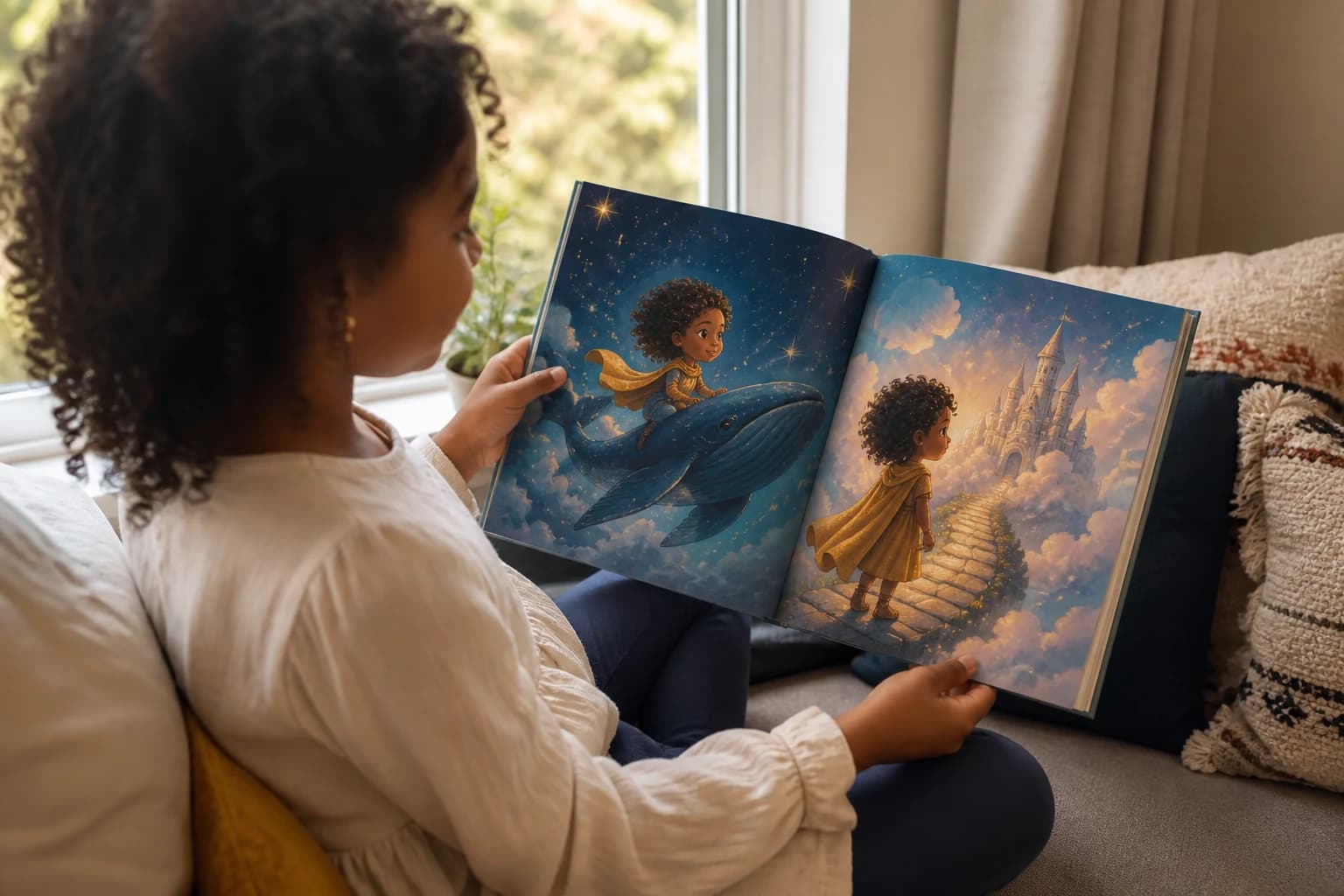
What is a personalised children’s book?
A personalised children’s book is a picture book written and illustrated around one specific child. The child’s name appears in the text and the hero is drawn to look like them; many books also reflect their age, interests or a moment in their life.
The term covers a wide range: from a fixed story that swaps in a name and a menu-built avatar to a plot, vocabulary and illustrations made for one child. In American English it is spelt personalized; it is the same product.
- Name: in the title, the text and sometimes the pictures.
- Appearance: hair, skin tone, eyes, glasses.
- Age: vocabulary and sentence length.
- Story: a favourite theme, such as dinosaurs or space.
- Message: courage, a new sibling, sleeping alone, starting school.
- Dedication: a note from the giver.
- Language: the one spoken at home.
How is a personalised book different from a regular picture book?
A regular picture book tells the same story to every reader, with characters the child watches from the outside. A personalised book puts the reader inside the story: the child finds their own name and face at the heart of the adventure.
| Aspect | Regular picture book | Personalised book |
|---|---|---|
| Main character | Invented by the author | The child who receives it |
| Story | The same for every reader | Adapted to the child’s name, age or situation |
| Illustrations | Fixed | A character who resembles the child |
| Price | Set by the publisher | Often higher per copy |
| Best for | A varied library | Gifts, milestones and the child’s own story |
Early-literacy research suggests personalisation changes how children engage. In one small study, three-year-olds made more comments about themselves during personalised passages. In another, children of almost four remembered new words from personalised passages better a week later. Both samples were small, so read them as encouraging signals, not proof. More in the benefits of personalised books.
What types of personalised children’s books are there?
There are three main types: template books where you insert a name and build an avatar, AI-illustrated books made from the child’s photo, and books commissioned from an illustrator. Each can be printed, digital or both, and they differ in likeness, flexibility and price.
- Template with an avatar builder. A pre-written story with the name inserted and a cartoon chosen from a menu. Quick and predictable, but generic.
- AI-illustrated from a photo. Illustrations of a character based on the child’s features, often with a story adapted to age and theme. Quality depends on consistency checks and text review.
- Commissioned illustrator. An artist draws the child from photos. It is the most handmade option and usually the most expensive and slowest.
- Printed or digital. A format choice, not a type: any of the above can be a hardback, paperback, PDF, e-book or online reader.
| Criterion | Template + avatar | AI-illustrated from a photo | Commissioned illustrator |
|---|---|---|---|
| How the child appears | A cartoon chosen from a menu | A character based on the photo | A hand-drawn portrait |
| Likeness | Approximate | Can be close; varies by service | Close; depends on the artist |
| Story | Fixed, with the name inserted | Often adapted to age and theme | Written or chosen with you |
| Time to receive | Fast if digital; days if printed | Varies; longer if printed | Usually weeks |
| Relative price | Lowest | Middle | Highest |
How are AI-personalised children’s books made?
An AI-personalised book usually starts with a photo and a few details about the child. The service creates a visual reference for the character, writes a story for the child’s age and theme, generates each illustration from that reference and checks the pages before delivery.
- Details. A parent gives the child’s name, age and a clear photo, and picks a style, theme and message.
- Character reference. The photo becomes a fixed description of the face, hair, skin tone and distinctive features.
- Story. A language model writes to a brief (age, theme, message, length); careful services limit vocabulary and review the text.
- Illustrations. An image model draws each scene from the reference, so the hero stays the same child.
- Checks. Pages are compared with the reference; drift such as a new hair colour or an extra finger should be redrawn.
- Preview and delivery. Part of the book is often shown first; the full book follows as a file, an online reader or a print order.
The hard part is not one lovely picture but the same face across 12 or 24 pages, and text that sounds like a real children’s book. More in how AI children’s books are made.
What makes a personalised children’s book good?
A good personalised book reads well aloud, fits the child’s age, keeps the same character on every page, uses natural language rather than machine translation, and comes from a service that explains how it handles the photo and shows a preview before payment.
- Writing. Read a sample aloud: a real problem, a resolution and a child who acts rather than watches.
- Age fit. Short sentences and repetition for a two-year-old; a proper plot for an eight-year-old.
- Consistency. The same face, hair and skin tone from the cover to the last page.
- Likeness. Not a photograph, but the child should say “that’s me!”.
- Language. Written natively, not translated word for word.
- Preview. A look at the cover or a page before paying.
- Privacy. Clear answers on storage, third parties and deletion.
- Formats. Print, PDF, e-book or online reader, and how to reopen it later.
- Support. A way to correct mistakes after purchase.
Our checklist for choosing a personalised book turns these criteria into questions to ask.
Printed or digital, and how much do personalised books cost?
A printed book is a physical keepsake but takes longer and costs more with printing and postage. A digital book arrives faster, opens on any device and usually costs less. Price depends mainly on format, length and how much human work goes into each copy.
| Aspect | Printed | Digital |
|---|---|---|
| Delivery | Printing plus postage | Download or online access |
| Durability | Physical object; can wear out | Never wears out; needs a screen |
| Sharing | One copy in one home | Easy to share with family far away |
| Reading | On paper, no screen | Tablet, phone, computer or e-reader |
| Cost | Higher; includes printing and shipping | Usually lower |
What drives the price:
- Format: hardback, then paperback, then digital.
- Length: more pages mean more illustrations and text.
- Human work: an illustrator’s hours cost more than automated generation.
- Extras: narration, video, gift boxes and express delivery are often charged separately.
- Pricing model: most books are one-off purchases; some services sell subscriptions or credits.
What age is a personalised book best for?
Personalised books work from about two to twelve. Toddlers enjoy hearing their name and spotting themselves; four- and five-year-olds follow a simple adventure; from six, children read parts alone and want a real plot. Above all, the text must suit the child’s actual age.
| Age | What works | What to check |
|---|---|---|
| 2–3 | Short sentences, repetition, routines | Very little text per page |
| 4–5 | A simple quest; feelings named | A clear beginning, middle and end |
| 6–7 | Early reading: finding their name, short lines | Clear type, manageable sentences |
| 8–10 | Richer words, humour, twists; anime or 3D styles | Nothing that feels babyish |
Under-twos enjoy personalised board books for the pictures and the sound of their name; beyond ten, the book is more often a keepsake. See personalised books by age.
When is a personalised book a good idea?
Personalised books suit birthdays and Christmas, and also life moments: a new baby, starting school, moving house, sleeping alone or facing a fear. A story in which the child copes well makes the change easier to talk about.
- Birthdays and Christmas: see our personalised book gift ideas.
- A new sibling: the child as a proud big brother or sister; see books for a new sibling.
- Bedtime: a calm story for the evening routine; see personalised bedtime stories.
- Starting school: a hero who walks in bravely on the first day.
- Family far away: a digital book can be shared on a video call.
- World Book Day or learning to read: a reward for a new reader.
Is it safe to upload a child’s photo for a personalised book?
It can be, if the service is transparent. Check who stores the photo, which third parties process it, when the original is deleted, whether it is used in advertising and how to request deletion. Vague answers are a reason to wait.
- Is it kept in private storage?
- Which providers process it, and why?
- When is the original deleted, and what is the maximum retention?
- Is it sold, used in marketing or used to train models?
- Can you request access, correction or deletion?
- Must you confirm that you are the parent or have permission?
Use a photo of the child alone, with nothing that reveals a school, address or location. More in child photo safety.
How does Heroica make personalised books?
Heroica makes digital, AI-illustrated personalised books for children aged 2 to 12, in English, Brazilian Portuguese, Spanish and French. A free preview shows the cover and first page before a one-off payment. There is no print edition, no audiobook included and no subscription.
Heroica (heroicabooks.com) publishes this guide; here is how it applies the criteria above.
- A parent or authorised adult uploads a clear, front-facing photo with the child’s name, age and, optionally, gender.
- You pick an art style (watercolour, 3D animation, anime, coloured pencil or classic) and a theme (under the sea, outer space, dinosaurs, enchanted forest, castle, circus or your own).
- You pick a message (courage, friendship, believing in yourself, respecting differences, kindness, perseverance, sleeping alone, a new sibling or your own) and an optional dedication.
- The free preview, with the illustrated cover and first page and the story text, is usually ready in 2 to 3 minutes. No account or card.
- The book comes in 12, 18 or 24 pages. Payment is one-off through Stripe, by card (in Brazil, Pix too), and you see the preview before paying.
- The complete book arrives as an online reader, PDF and EPUB; preparation time varies with illustration generation.
Each language is written natively, not machine-translated from English, and vocabulary and sentence length follow the child’s age.
| Market | 12 pages | 18 pages | 24 pages |
|---|---|---|---|
| English (USD) | US$17 | US$27 | US$37 |
| Brazil (BRL) | R$47 | R$67 | R$97 |
| Spanish and French (EUR) | €17 | €27 | €37 |
The same face on every page. The photo becomes a fixed character sheet; every illustration starts from it, an automatic check compares each page with it, and anything off-model is redrawn before delivery.
Photo. The original sits in private storage and goes temporarily to KIE AI, an image-generation provider; it is deleted once the character sheet and the preview images no longer need it. Unfinished orders have the photo scheduled for clean-up after 24 hours, and the original is kept for 30 days at most. Photos are not sold or used in advertising, and parents can request access, correction or deletion.
After purchase. Books stay in “My orders”, opened with a code sent by email instead of a password. For questions, just send an email.
Optional extra. After buying the book, a horizontal animated video (480p) with the whole story narrated in its language: US$97, R$197 or €87, paid once.
Frequently asked questions
Do personalised books work for children who can’t read yet?
Yes. An adult reads aloud, and the joy lies in hearing their own name and spotting themselves in the pictures. Choose little text per page and plenty of repetition; soon the child will “read” favourite pages from memory.
What kind of photo gives the best result?
A recent, sharp photo of the child alone, facing the camera in natural light, with the whole face visible. Avoid sunglasses, hats, heavy filters and group shots.
Will my child recognise themselves in a cartoon or anime style?
Usually, if the defining features survive: hair colour and shape, skin tone, glasses, freckles. Stylised art simplifies faces, so likeness comes from those cues. A preview is the best test before paying.
Can grandparents or godparents order a personalised book?
Yes, with the parents’ permission to use the photo. Responsible services ask the person uploading it to confirm they are the parent or authorised. Agreeing first also avoids duplicate presents.
How long does a personalised book take to arrive?
Digital books are delivered online, so they usually arrive much sooner; printed books add printing and postage, which can take days or weeks. For a birthday or Christmas, check the stated timescales and order early.
Can I get a personalised book for a bilingual child?
Yes. Some services write in several languages, so you can pick the language of home or school. Check that the text is written natively, not machine-translated. Heroica, for example, writes in English, Brazilian Portuguese, Spanish and French.
Sources
- Natalia Kucirkova, David Messer, Kieron Sheehy (2014). The effects of personalisation on young children's spontaneous speech during shared book reading. Journal of Pragmatics, 71, 45–55
- Natalia Kucirkova, David Messer, Kieron Sheehy (2014). Reading personalized books with preschool children enhances their word acquisition. First Language, 34(3), 227–243
See your child as the hero — free
Create a free preview with the cover and first illustrated page. No account, no card — you only pay if you like what you see.
Create the free previewKeep reading
How to choose a personalised children’s book: a checklist
A practical checklist for choosing a personalised children’s book: what to compare, red flags, questions to ask about the photo and how to judge a preview.
Read the guide →Personalised books by age: what works from 2 to 12
How to choose a personalised children's book by age: text per page, vocabulary, themes, pictures and whether 12, 18 or 24 pages suits a child aged 2 to 12.
Read the guide →AI personalised children’s books: how they work and what to expect
How AI turns a photo into a storybook character, why faces can change between pages, where AI slips and how it compares with a human illustrator.
Read the guide →Is it safe to upload a child’s photo to an AI book maker? A privacy checklist
Before uploading a child’s photo to an AI book maker, check who processes it, how long it is kept, consent, location data and your rights under GDPR.
Read the guide →